Showing posts with label Mathematics Activities. Show all posts

Sunday, August 22, 2010

Play and Work in our Montessori Homeschool

Ian is a challenge in homeschooling: he hardly engages with an "work" activity. However, it gets easier whever the activity has a "play" component.

In this respect, NAMC blog  posted an interesting article about "Play and Work in Montessori Education". Here is an extract:

Maria Montessori recognized that imagination or play was not the same as work, but she also appreciated that learning is most effective when play and work are united in a single activity ... Although we tend to think of work and play as in opposition to one another, they are most effective when they are brought together. Therein lies the genius of the Montessori materials. Form boards, for example, bring together both play and work. The child must mentally transform the form board, and the pieces to be placed within it, into a problem to be solved, the play component. Positioning the pieces into their proper places is the adaptation to reality, the work component. By bringing together learning tasks which unite work and play Montessori was able to mobilize the child’s personal motivation for the purpose of social learning. As Montessori’s curriculum materials make clear, a less misleading aphorism might be, “Play is the motivation for the child’s work.”
Last week I noticed Ian was very motivated peeling and sticking band-aids (let's say, the work component) of the "Toy Story" movie figures (let's say, the play component). He had fun and, at the same time, he improved his fine motor skills and space awarness as he was not arranging them mindlessly. I think the key is to determine if he is really engaged in a "purposeful activity" and I think he was.

I've been  reluctant to mix play with work because I was confused about fantasy vs. Montessori, but after I saw how much Ian enjoyed that band-aid activity, I was thinking about that and asked Karen Tyler, about her take on it. She explained it to me:

During the time that Maria Montessori lived and in the country where she lived, fantasy consisted of fairy tales and the purpose for telling your children Fairy Tales was to scare them.....and they were scarey! Just think about Hansel and Gretel being put into an oven by a witch for trespassing and you get the picture. Well, we don't live during the time that Maria did...we live in 2010. We live in a place and at a time when cartoons and fantasy are all over the place and children are exposed to them from birth.....there are many wonderful fantasy figures and even the ones that aren't can be used to teach a lesson ... Real life includes being able to think original thoughts and in order to develop this skill a child needs to daydream and have exposure to good fantasy.
On the other hand, Colleen  at Sunrise Learning Lab gave me some great advice concerning Ian's fantasy interests, in order to:

... do things like have him work on topics that are related to his imaginary play, such as real space info if he likes Buzz Lightyear, or real information on cowboys and horses if he is a fan of Woody.
I think I must wait for Ian to get a bit older to introduce themes like that, but that is the direction I want to take in the future. For now, here is what I am doing : I am finding out what Ian absolutely LOVES, following my child and using his interests to create works. At this moment, he is drawn to the fantasy figures from books and movies then, this week I included objects related with the movies "Nemo", "Cars", "Toy Story" and "Thomas the Tank Engine" to create activities and, Ian could not resist them! I think Ian knows what is real and what isn't, that the characters are pretend and he is just having fun with them.

Before presenting the activities Ian did this week, I want to confess something: my camara broke in the middle of the week and at first I felt depressed. I've been taking photos to Ian since he was born, but since I started blogging, photographing him has become such a "must" to illustrate my posts. Ian seems to be used to it and I thought I was not disturbing him while he was working; but, just now since I don't have a camera I've noticed he enjoys it more when I observe and support him. I have had time to observe him and  it really makes a great difference. This week I gave Ian complete freedom to decide when and what work to do and we both enjoyed it. Great sign! Great lesson!

Having said that, let's check out what Ian did at homeschool this week.

Practical Life

Slotted spoon. As using a sifter was difficult for Ian, I got him to attempt using a slotted spoon to separate flat marbles from a bowl filled with rice and then transfer them to another bowl. I put the flat marbles on the top of the rice to ease Ian's work. It took some time for Ian to catch the right motion and finally he learnt to spoon superficially the rice because if he spooned too much rice, the spoon became heavy and more difficult to shake. I liked how he understood the purpose of the activity. He was very observant to be sure that no rice grains fell into the bowl with the flat marbles or on the tray. When that occurred he grasped the grains and put back into the rice bowl.

Usando una espumadera para separar canicas
planas y arroz

Cutting and sticking paper with adhesive tape. Lately he's been focused on cutting the tape from the dispenser by himself. We have tape strips stuck everywhere in our house. I printed and cut diverse figures of animals to teach Ian how to stick paper using the tape, but he did not get the idea of where to place the tape to adhere the figure to the paper and lost interest quickly. This week I printed and cut figures from the  "Toy Story" movie and I got him so focused that he did cut the tape from the dispenser and placed the tape through the figures ... well, he placed too many strips but it was good practice. Look how proud he was admiring his work. Now we have the figures stuck on the wall :-)

Cortando cinta scotch del porta cinta y pegando figuritas

Spooning. Spooning was never a task that Ian enjoyed. To give him spooning practice at mealtime I put the food in bowls and provided him with different kinds of spoons to let him serve it on his plate. Honestly, I thought that after that practice, he would not need to do spooning activities. In order to prove it, I set up the first spooning activity, it is from bowl to bowl, but again he was not interested. So, I changed one bowl for a ice-cube tray and got Ian's attention. I could see the broader purpose of the activity (as all the Montessori activities). It is not just to get the ability to transfer objects with a spoon, but to develop eye hand coordination, concentration and order. I could see that Ian's gotten better at this but needs more work. Well, although it is not a favorite activity he does it once a day. He is learning not to use his non-dominant hand to make the task easier. At first he did not care about where and how many marbles he put on the tray; now he is very attentive looking for one empty space (he does not do it sequentially yet) and when one marble falls into a filled space he spoons it and moves to an empty one.

Usando una cuchara para transferir canicas planas
a una cubetera de hielo, una por una

Sensorial

Sorting erasers. Sorting is another activity Ian hardly has interest in. I've been looking for real-life objects that could be attractive for Ian and finally I found erasers with figures from the movie "Cars" (that Ian's never seen). I bought four sets of four figures and set up a tray with four dot stickers to guide Ian where to place each group. He got the idea very quickly and completed the full cycle of the activity (he rarely reverses the process) and starts over and over again. As part of the activity, he must also pile the eraser of each group and he was very careful to get them perfectly aligned.

Clasificando y apilando borradores con figuritas de
la pelicula "Cars"

Size discrimination. We have the Pink Tower, but Ian does not work very often with it. So, I am trying convensional methods to help Ian develop his visual discrimination of size, through the manipulation of pairs of objects with different sizes. As he is still enjoying the magnet tray I set up for him two weeks ago, I just placed the objects in the tray for Ian to gather them with the magnet and match it with the corresponding picture. At first, he paired the objects without considering the size of the picture, but now he seems more attentive to do this.

Atrayendo objetos con un iman, discriminando forma
y tamaño para emparejarlos con su correspondiente
imagen

Texture balloons.  I saw this idea in Chasing Cheerios and waited for Ian to get interest in sensorial activities to put them out. I filled four balloons with different substances (chickpeas, lentils, flaxseeds and flour) and let Ian squeeze them to stimulate his tactile awareness of diverse grades of grain. Later, I will put out another set of balloons (filled with the same substances) for Ian to find the matching pairs.

Explorando granularidad a travez del tacto con globos
rellenos con garbanzos, lentejas, linaza y harina

Matching picture-objects. I found a set of 12 plastic tropical reef fish and I knew Ian would love them, especially because they include a clownfish (like "Nemo"). The fish came in a plastic box with 12 compartments, perfect for exercises of transferring objects one at a time and one-to-one correspondence. I thought that Ian would examine the details of each fish, so I printed images of them (scanning the fish was easier than getting pictures off the Internet) and put them in the compartments. I thought that 12 fish might be too much for Ian, but he definitely has periods where he is attentive to "small details" and he enjoys checking each detail of the fish and looking for its place.

Emparejando peces tropicales con su imagen

Math

One-to-one correspondence. I stuck a long strip of tape on the floor, wrote numbers 1-to-10 and got Ian to park each of his trains sequentially in each numbered spot.

Correspondencia uno-a-uno: estacionando cada uno
de sus trencitos en un estacionamiento (numerado)
exclusivo

Language

Emotions.  I want Ian to learn how to identify and communicate his emotions and our first approach was know the different ways he can feel. He likes the book  The Way I Feel, the emotions presented in words and pictures include: silly, scared, disappointed, happy, sad, angry, thankful, frustrated, shy, bored, excited, jealous, and proud.  He is not very interested in the text so much, but in the pictures and names of the feelings and especially in making faces to represent each of them.

Representando y nombrando distintos sentimientos
 ilustrados en el libro The Way I Feel

I am sharing this post on One Hook Wonder where you can see other toddlers learning according to the Montessori Method.

Sunday, August 8, 2010

A spirited boy at work

Ian is revealing to us his spirited personality. He is very sprightly when he plays. He is very much into jumping, climbing, rolling. He is challenging his body and …. his luck also. He’s had some accidents recently: his face is full of bruises, his lips are cut and a big toe lacks of nail, but it does not seem to matter to him. He just keeps going nuts and driving us crazy.

Fortunately, that naughty boy of two weeks ago received the attention he was begging for and, even when he is very resolute when he is playing riskily, he is not behaving aggressively anymore and this week he was very enthusiastic at work. He was very animated with most of the activities I set up for him. And he finally found a place where he feels comfortable to work: the dining table. There he has his materials all around the table.

Well, here is what we did:


Practical Life

Using a hammer. I'd put out this activity a number of times and it never enthused Ian until this week. The hammer was one of the objects included in a matching activity (see below) and the most attractive for him. He gets very excited when he finds something whose name he can pronounce (even incorrectly). I was happily obliged to gather together the hammering activity again and this time Ian was ready to do it and enjoy it. His motor skills were quite good to hammer the golf tees until they were completely nailed into the styrofoam. Another thing he liked was to push down the golf tees with his fingers. I was so happy Daddy was at home to share with Ian, what a lovely picture they presented me. Ian, of course, tried to interchange his hammer with Daddy's :-) but he didn't have luck this time :-)


Making bubbles with a whisk. The Work Plan reminded me I was waiting for Ian to get some skills with the grater to set up this activity. He enjoyed every step of the activity: grating the soap bar (a wet one to make his job easier), feeling the texture and smell of the grated soap, observing how it submerged in the water, beating the water with the whisk and watching the bubbles. He needs more practice with the whisk, he did not move it in small circles in the water, but moved it in and out :-) I helped him to make the bubbles.


Tweezer. The tweezer was a thing that was in the science activity of the week (see below) and he grabbed it with thumb and fingers and started to clamp his toes with it :-) I took that as a sign he was probably ready to transfer objects with the tweezer. He did it, he transferred pom-poms! ... but, the next time he attempted to grasp it in a different way (maybe looking for a easier way) and it did not work, he gave up the activity. As he is very obstinate I decided to rotate this activity for later.


Buttoning. This is another old activity that captured Ian's interest for the first time. When I made this mat Ian had not developed visual discrimination skills yet and he just pulled the pieces of felt off the buttons and threw the mat away.  This time, as usually, he did not let me present the activity and went directly to what he thought the activity is about: matching colors :-) He did it perfectly. I helped him to button, but he was so focused on matching and unbuttoning that he did not pay attention to my demonstration. Once more, I have to step back and wait for his own due time to start buttoning.


Language

Object-Silhouette Matching. Ian is very much into matching. He is not interested in matching objects to objects or pictures to pictures, but rather objects to pictures!!! This week we moved to matching objects with silhouettes and it was a hit. He loves to work with familiar objects and learn their names.


Science

Exploring with magnets. This was the winner activity of this week!!! Ian did it every day over and over again, so I had to set up some variations to satisfy his curiosity.

Well, Ian is not interested/ready for categorizing activities, but this version seemed perfect for him. As Ian is enjoying matching I used pictures to help him know how many more objects are left to find in the oatmeal tray. I've never seen Ian so amazed and interested in something than the power of a magnet.


When Ian discovered that magnetism travels through objects, he spent a long time gathering everything together. I gave him a screwdriver for further experimentation.


As he mantained his interest in this activiy I added objects to the tray and printed the corresponding pictures.


Sensorial

Oats tub. I've seen lots of sensorial tubs over many blogs and doubted tha Ian would be engaged with them, besides I do not have any "interesting" things to put inside them. Well, I was wrong. The science tray not only captured Ian attention to accomplish the magnet experiment, but he enjoyed exploring it with his hands too. So, I put the rest of the otameal in a tub and he spent a fun time making mountains of oats with his hands (he did not want to use the scoop). When I showed him how to drop them, he was very excited doing it.


Big and Small.  This is our official first activity (not counting the Pink Tower) to learn about big and small and it was not very appealling to Ian, at least not to discrimate size. Well, what is this activity about? I gave Ian farm-related stickers to stick the big ones in one column and then match and stick the small ones in the next column. I hoped that he would be interested in the contrasting size of the stickers, but he was loyal to his current interest in sticking, peeling, matching and naming the stickers.


Math

One-to-one correspondence. Daddy and Ian usually read at bedtime. Lately, they've been counting together anything in the books while reading. Daddy asks Ian, "how many ... do you see? Let's count!" and Ian points one by one to all the things only once. It is a great advance. For now he lets Daddy count the numbers, even though he knows them.


I am sharing this post in One Hook Wonder where you can see other toddlers learning according to the Montessori Method.

Sunday, August 1, 2010

Diversifying activities

Ian is growing every day and his interests have been diversifying. We still spend the major amount of time doing practical life and visual discrimination activities, but I've been looking for other activities in areas like: science, sensorial, language and math that could capture Ian's interest. Last week we did a "float and sink" science activity and this week we explored smells, stressed in language while working in matching activities and introduced patterns.

Here is the review of the activities:

Practical Life:

Arranging Eggs. Ian is always ready to help with eggs. He usually helps me peeling and cracking them and  this week he enjoyed transferring the eggs from the cardboard tray to refrigerator trays. He has learned to take the eggs carefully without breaking a single one. This activity has reinforced the concept of one-to-one correspondence.


Preparing mashed potato. Every time I cook I try to involve Ian as much as possible according to his skill level and this week I thought that he was ready to prepare mashed potato: he used the potato masher, pressed it down (he did not do a twist motion); shook salt and pepper shakers and said "too much!" :-) just as Daddy says to him every time Ian plays with the spice shakers; spooned the margarine and stirred it all up.


Sweeping into a dustpan. This is a house chore Ian wants to do by his own every time he sees me with the dustpan and brush. He has been sweeping rose petals and getting better at it.


Hair barrettes and headbands. I had seen this activity in My Montessori Journey. I am sure Daddy will say this is a girly activity :-), but I say it is a fun fine motor skills and sensorial activity ... and Ian likes it a lot!!!
I got two pairs of barrettes and two pair of headbands of the same color and Ian had to unsnap every barrette and then snap it onto a matching color headband. Unsnapping and specially putting the headband inside the barrette and snapping it, challenged Ian's concentration and fine motor skills.


Pre-Reading Skills

Matching picture to object. We've been working with matching pictures to silhouettes and I recently realized I should start with matching objects and gradually move to more abstract matching activities such as the silhouette ones. Well, while I was looking for pairs of objects to match, I set up two picture-to-object matching activities. The first set contained objects we found around the house (actually it was aimed at attracting Ian's interest) and the second one contained vegetables and fruits. I know for this activity I should use picture cards and teach Ian how to order the cards one by one from left to right, horizontally, before doing the matching, but for now the less formal the "lesson" the most likely that Ian will be engaged with it. Well, Ian enjoyed both activities and did them pretty well.


Sensorial (and more fine motor skills)

Color matching with dot stickers.  I was using color dots stickers to prepare material to introduce patterns, when Ian started sticking the stickers everywhere. So, I improvised a simple worksheet with color dots to give him something more interesting to do.


Pipe cleaner and beads.  The original version of this activity come from Itty Bitty Love. I changed it a bit and got Ian busy pushing pipe cleaners (of primary colors) into the holes of a shaker and then stringing same-color beads onto the pipe cleaners.


Art

Spice Collage. As I told you in previous posts, Ian likes to mix chopped vegetables before I put the saucepan on the stove. Lately, I also let him spice the mix and I've noticed that Ian likes to smell the spice bottles and somethimes he ventures to taste the spices. Since then, I have been thinking of Montessori smelling bottles, but I think that Ian is not ready yet to pair or classify the smells, so I preferred to set up an art activity where Ian can explore multiples smells. All we needed for this activity was paper, spice bottles and glue and maybe a paintbrush. Ian dribbled glue on the paper (he was not interested in using the paintbrush to spread the glue on the paper), then he took his time to open each spice bottle, smell it, shake it if it had a hole top or otherwise pincer grip the spices and sprinkle them over the paper.
What I loved about this activity was how it encouraged Ian to touch, smell, see, and even taste.
It also is a great opportunity to get further practice with lids. Fortunatelly, I have different spice bottles, some require to be screwed and others lifted. Ian almost forgot what he was doing when he discovered the paprika can, he spent a lot of time opening and closing the three different tops.
Another thing that I liked about it was that it is easy to clean up. This reminds me of the experience of Nicole at One Hook Wonder with glitter :-)


Finally, I love the exquisite aroma of the picture!!!


Pre-math skill

Introducing Pattern. In order to build math readiness skills, I've involved Ian in activities aimed at developing number recognition and one to one correspondence. Now, I want to introduce sequencing activities so that Ian begins to recognize, describe, reproduce, extend, create and compare repeating patterns. I am looking for fun activities to get Ian into it, but first I wanted to know what is our starting point using this homemade material.


I noticed that even when Ian put the ring on the correct pin (according to the color) he did not do it sequentially. And when I put the pattern card in the tray, he did not follow it at all, he put the rings on any pin.


So, I prepared a playful  activity to start talking about patterns. I printed two sets of this Hungry Caterpillar Cut and Paste worksheet, colored both, used one to build the pattern and give the pieces of the other to Ian and I was surprised that he could alternate the blue and green pieces mostly well.


I am sharing this post in One Hook Wonder where you can see other toddlers learning according the Montessori Method.

Friday, May 14, 2010

Counting activities for Toddlers / Actividades númericas

Since Ian was a baby I have counted things out loud. During snuggle time he likes me to count his toes and fingers, or the kisses I gave to him. When I make up a bottle for Ian, I count out the scoops of powder. When we use an elevator, we count the floor numbers. Playing counting games is part of our daily routine. For example, at the swimming pool Ian stands on the edge of the pool, Daddy holds out his arms to him and says, “One, two, three, Jump!” To him this is a very exciting game and it was actually where he began to count out loud! Now he is the one who counts out the scoops of milk powder every time we make up his bottle (sometimes he scoops the milk as well).

Desde que Ian era un bebé yo cuento cosas en voz alta. Cuando regaloneábamos a Ian le gustaba que le cuente sus deditos de pies y manos, o los besos que le daba. Cuando preparaba su biberón, contaba las cucharadas de leche en polvo. Cuando utilizábamos el ascensor, contábamos los números de los pisos. Los juegos también fueron parte de nuestra rutina de contar cosas. Por ejemplo, cuando vamos a una piscina a Ian le gusta pararse en el borde, Daddy estira sus brazos hacia él, y le dice (en ingles) “uno, dos y tres, salta! Para él, esto es muy emocionante y en realidad fue donde comenzó a contar en voz alta! Ahora, él es quien cuenta con las cucharadas de leche cada vez que preparamos su biberón (a veces él echa la leche).

Definitely, hearing the words "one, two, three…" over and over stuck in Ian's mind. It became a routine and when he began to talk, it was already in his brain, ready to use as soon as he feels able to pronounce them! I remember when he started to count up to 5 he skipped number three until he got the pronunciation.

Definitivamente, escuchar las palabras "uno, dos, tres..." una y otra vez, más fijó los números en la cerebro de Ian. Estos se convirtieron en una en una rutina y cuando comenzó a hablar, ya estaban en su mente, listos para ser usados tan pronto como él se sintiera capaz de pronunciarlos! Recuerdo que cuando empezó a contar hasta 5 él se salteaba el número tres hasta que logro pronunciarlo.

I think he learnt numbers 6 to 10 listening (and dancing) over and over again to the song “This Old Man”.
I really hadn’t paid too much attention to counting games lately until he astonished us by counting up to ten voluntarily while in his swing.
Then I wondered if he could recognize the numbers. So when we read his book “Hippos Go Berserk”, I asked him to say the numbers while I was pointing at them on each page. He did it well for 1 to 5.

Yo creo que él aprendió los números del 6 a 10 escuchando (y bailando) una y otra vez la canción This Old Man.
A decir verdad, últimamente no había puesto mucho énfasis en juegos de contar hasta que Ian me sorprendió contando hasta diez voluntariamente mientras se columpiaba. Entonces tuve curiosidad por saber si podía reconocer los números. Así que apenas pudimos leer su libro Hippos Go Berserk, le pedí que dijera los números mientras yo le señalara estos en cada página y lo hizo bien del 1 a 5.

After that I included magnetic numbers on the refrigerator, foam numbers in the bath tub with water, cookie cutters and coloring pages and he is improving at number recognition.

Después de eso, incluí números magnéticos en el refrigerador, números de fomi en la bañera o en la piscina, cortadores de galletas numéricos y páginas para colorear números y él está reconociendo mejor los números.


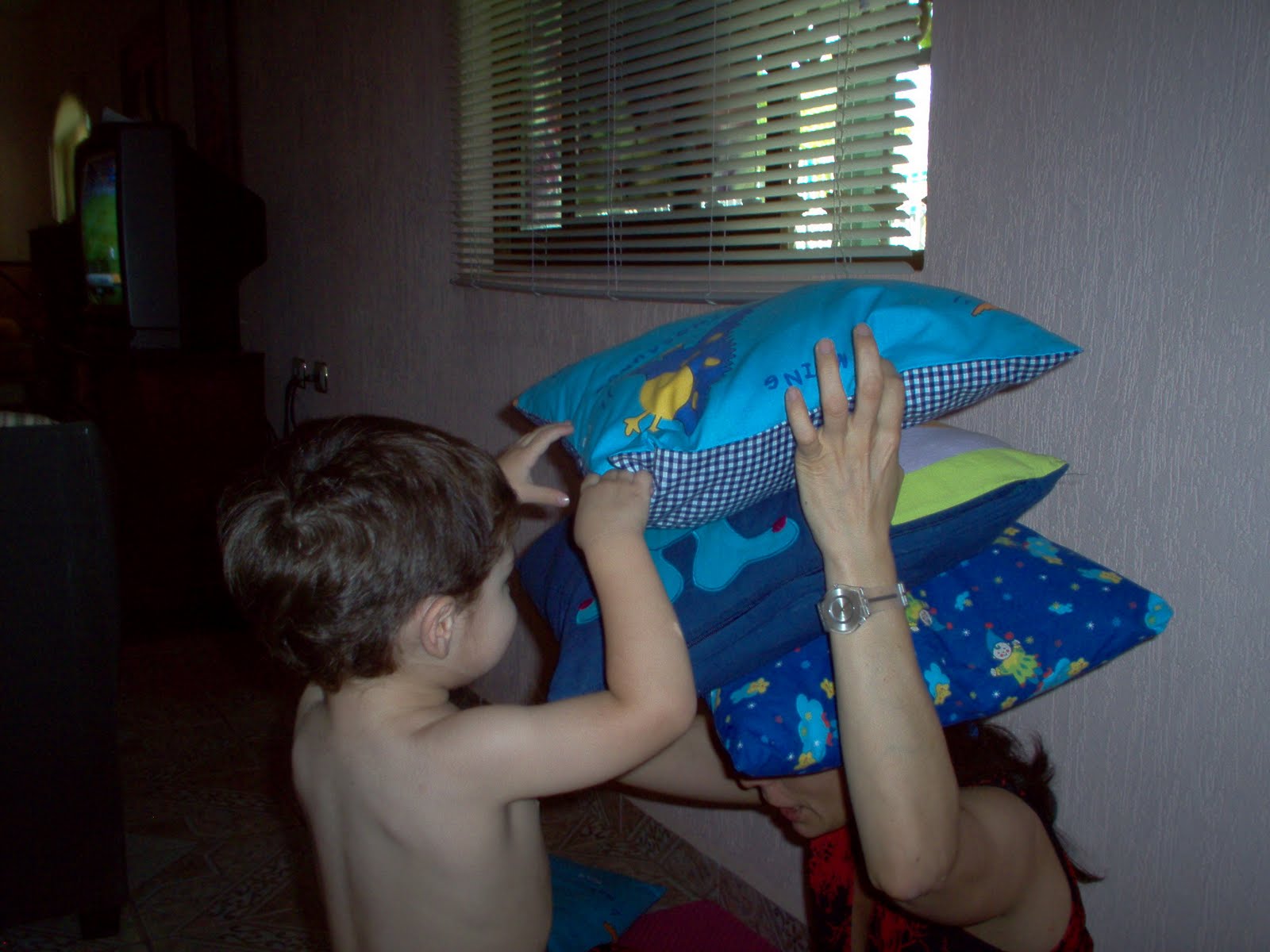
As we do not have a library here (and we must wait a month for Amazon shipments) I looked for some videos in Youtube. Ian loves Dr Seuss and “Ten Apples up on Top” has caught attention. As he engages very well with silly things, I began to play with books on top of me and he laughs a lot each time the book pile falls and now he plays the same game with his cushions, up on him and up on me, while counting. I noticed that although the sequence was correct, sometimes he counts one cushion twice. Then I realized that he does not understand the concept of one-to-one correspondence and especially that counting is more than just saying the number by rote.

Como no tenemos una librería aquí (y debemos esperar un mes para recibir los envíos de Amazon) busque algunos vídeos en Youtube. A Ian le encantan los libros de Dr. Seuss y “Ten Apples up on Top” captó su atención. Como él se involucra mejor en actividades si hacemos cosas absurdas y divertidas, empecé a poner y contar libros encima de mi cabeza y él se rio mucho cada vez que la pila de libros se caia. Ahora él hace el mismo juego con sus cojines, sobre él y sobre mí. He notado que, aunque la secuencia de números es correcta, a veces el cuenta un cojín dos veces. Entonces me di cuenta que no entiende el concepto de correspondencia uno-a-uno y especialmente que contar es más que simplemente decir los números de memoria.


After I read the chapter Mathematics Activities of Gettman's book, I was considering sensorial materials like Red Rods, Pink Tower, and Cylinder Blocks to prepare Ian’s skills for mathematics.
As we are following Lisa Nolan Curriculum for Toddlers I asked her for suggestions and this is what she said:

"If your child is 26, this is still too young to combine numbers and quantities over the number two or three, and even though your child may be able to do that, it is not a strong interest, yet.
Gettman's book is for ages three and up, and sensorial materials are more popular with that age group, less so with toddlers (this would include the number rods). So wait 10 to 12 months for your child to show a strong interest in sensorial materials and number rods.
Practical life activities are indirect preparation for math: there are a number of steps and a sequence of steps, so I'd focus on simple practical life. And toddlers love practical life, especially if it includes water! So continue with counting, and with numbers, wait on putting them together with number rods."


Después de leer el capítulo Mathematics Activities del libro de Gettman, estuve considerando usar materiales sensoriales como la Barras Rojas, la Torre rosada, Cilindros con Botón, para preparar las habilidades de Ian para las matemáticas.
Como estamos siguiendo el Curriculum para Niños Pequeños de Lisa Nolan, le pregunte su opinión al respecto y esto fue lo que me dijo:

"Si tu hijo tiene 26 meses, es demasiado joven para combinar números y cantidades mayores dos o tres y, aunque el niño puede ser capaz de hacerlo, es no es un fuerte interés, todavía.

El libro de Gettman es para niños de tres a cinco años, y los materiales sensoriales son más populares con ese grupo de edad, y menos con niños pequeños (esto incluye el las Barras Numéricas). Entonces, espera entre 10 a 12 meses para que tu hijo muestre un fuerte interés en materiales sensoriales y Barras Numéricas.

Las actividades de Vida Práctica son una preparación indirecta para las matemáticas: hay una serie de pasos y una secuencia de pasos, así que yo me enfocaría en actividades de vida práctica simples. Y los niños pequeños les encantan estas actividades, especialmente si se incluye el agua! Así que continua con actividades de conteo, y con números y espera para ponerlos juntos usando Barras Numéricas".

LinkWithin

Related Posts with Thumbnails