Showing posts with label 26 Months. Show all posts

Saturday, May 22, 2010

Eye-hand coordination / Coordinación ojo-mano

Last days Ian's had fun working on a pair of activities aimed to develop his fine motor skills, specifically his ability to execute activities with his hands, guided by his eyes requiring accuracy in placement, direction, and spatial awareness.

The first activity was an extension of the sticky tape collage activity. Ian had to stick the strips of masking tape I tore previously onto rectangles that I draw in different directions. The transparent or semi-transparent tape, like the one we used, works best for control of errors.

Los últimos días Ian se entretuvo trabajando en par de actividades para desarrollar su motricidad fina, específicamente su capacidad de ejecutar actividades con las manos, guiándose por sus ojos. Ambas actividades requieren de precisión en la colocación, dirección y conciencia espacial.

La primera actividad es una extensión del collage de cinta adhesiva. Ian tuvo que las tiras de cinta adhesiva que corte previamente y pegarlas sobre rectángulos que dibuje en diversas direcciones sobre papel. La cinta transparente o semi-transparente como la que usamos funciona mejor para control de errores.


The second activity was an extension to the art activity collage of stickers, but in this opportunity Ian sticks the stickers onto the circles printed on paper.

La segunda actividad es similar y es una extensión a la actividad collage de stickers. En esta oportunidad Ian pegó los stickers sobre los círculos impresos en papel.

Friday, May 21, 2010

Perception of Colors / Percepción de colores

The first Montessori material I attempted to show Ian was color tablets (about two months ago), but he didn’t give me a chance to explain anything. He just grabbed the color tablets and started playing with them, not paying any attention to my presentation/explanation. After some failed attempts I rotated the color tablets off the shelf. One month later, I tried again (what a optimistic mother!) but things didn’t change. Since then, I have been trying different things, like:

El primer material Montessori que traté de mostrar a Ian fueron las tarjetas de colores (alrededor de dos meses atrás), pero él no me dio ninguna oportunidad de explicarle nada. Él sólo agarró las tarjetas y comenzó a jugar con ellas y no puso ninguna atención a mi presentación. Después de algunos intentos fallidos I retire las tarjetas. Un mes después, intenté una vez más (que optimista!) pero las cosas no cambiaron. Desde entonces he estado haciendo diferentes cosas, como:

  • When he was drinking his bottle, lying down in bed, I often presented to him the color tablets language activity with three-period lesson. Most of the time I spoke to myself (“Is this color red?” (Pause) “Noooo!” (Pause) “Is it red?” (Pause) ”Nooo!” (Pause) “Is it yellow?” (Pause) “Yeees!”. He watched me, expectant and smiling as I was changing my facial expressions and my voice tone. I played games to get him interested, for example, "What's missing?" During the three period lessons, I took one tablet away and asked him either "What tablet is missing?" or "Is the blue tablet missing or the red tablet missing?” Lately, he has been attempting to say the color names. Actually, the last time he painted, he asked for more “pain, pain” many times and while he was pouring it he said “elo”, or “ed” or “bu”. Although he did not correctly associate the name with the color I was still very happy.
  • I take advantage of our daily routine to talk about colors, while dressing up, doing playdough activities, coloring pages, painting, or playing anything.
  • Lately, as Ian is very interested in increasing his vocabulary, I have made a language card of objects with the primary colors. And when we finish a lesson using the color tables, I say something like “I will show you some objects which are red….”

  • Cuando Ian tomaba su biberón, tendido en su cama, a menudo le doy una lección de tres tiempos sobre los nombres de los colores usando las tarjetas de color. La mayoría de las veces estoy hablando sola (“Es este color rojo?“ (Pausa, esperando su respuesta) “¡Noooo! “ (Pausa) “Es rojo? “ (Pausa) “Nooo! “ (Pausa) “Es amarillo? “ (Pausa) “Siiii!”. El me mira, expectante y sonriente porque voy cambiado mi expresión facial y el tono de mi voz. Siempre trato de jugar para lograr su atención, por ejemplo jugamos a "Qué falta?". Durante una lección de tres tiempos, escondo una tarjeta y le preguntó "Qué tarjeta falta?" o "Es la tarjeta azul la que falta o es roja?” Y últimamente él ha estado tratando de decir los nombres de colores durante nuestras lecciones. De hecho, la última vez que el pintó, pidió más pintura muchas veces y mientras las vertía decía “elo” (por yellow) , o “ed” (por red) o “bu” (por blue) . Aunque no asoció correctamente el nombre con el color yo estaba tan feliz.
  • Aprovecho nuestra rutina diaria para hablar de los colores.
  • Últimamente, ya que Ian está interesado en incrementar su vocabulario, hice tarjetas de lenguaje de objetos con los colores primarios. Y cuando terminaba la lección usando las tabletas de colores, le decía algo así como: “ahora voy a mostrarte objetos que son rojos…”

At the same time I was reading Gettman’s book. He says that the emphasis in objects (like my vocabulary cards, at least, which are shown to “possess” various qualities, including the color in this case) to teach colors is a conventional teaching method, that perpetrates the objectification of the child’s world by subordinating experience to objects, while Montessori’s approach introduces the quality as a facet of the child’s experience.

Al mismo tiempo estuve leyendo el libro de Gettman. Ahí él dice que el énfasis en los objetos (como mis tarjetas de vocabulario, al menos, que poseen varias cualidades, incluido el color -en este caso) para enseñar colores es un método convencional de enseñanza, que perpetra la objetivación del mundo del niño al subordinar la experiencia a los objetos, mientras que el enfoque de Montessori introduce la cualidad como una faceta de la experiencia del niño.

After I read that, I was wondering: if my son is not interested in using sensorial materials, what should (and shouldn’t) I do to teach him color, shapes, dimensions, etc. according to the Montessori Method.

Después que lei eso me estuve preguntando: si mi hijo no está interesado en usar material sensorial, que tendría que hacer para enseñarle colores, formas, dimesiones, etc. de acuerdo al Método Montessori?

Then I wanted to test the results of my approach, so I put out a color sorting activity. I set up two bottles with two groups of sticks (I have tried red-blue and blue-yellow groups so far). The bottles and their lids have dot stickers with the same color as the sticks. He did the exercise pretty well and I noticed that he was not very enthusiastic, I feel like he was sending me a message to stop trying color matching activities, because he can do it already and he is not interested anymore.

Entonces quise probar los resultados de mis métodos, así que prepare una actividad para que Ian distiguiera los colores. Puse dos botellas con dos grupos de palitos de colores (probé rojo y azul y luego azul y amarillo). Las botellas y sus tapas tienen unos calcamonias del mismo color que los palitos. El hizo el ejercicio muy bien pero note que no estaba muy entusiasmado y sentí como si me estuviera diciendo que detuviera ese tipo de ejercicios porque ya puede hacerlos y a perdido interes.


I am learning (Ian is teaching me) that I have to rely less on the traditional Montessori materials and the traditional three period lessons. It’s best to teach and interact directly with my Little Piggy!

Estoy aprendiendo (Ian me está enseñando) que debo basarme menos en los tradicionales materiales Montessori y lecciones de tres tiempos para enseñar a Ian e interactuar con mi chanchito!

I will keep using our every day experiences and interactions to incorporate learning colors, shapes, etc. and increasing vocabulary, and maybe less on cards and tablets, for now!

Y continuaré aprovechando nuestras experiencias diarias e interacciones para incorporar aprendizaje de colores, formas, etc. e incrementar su vocabulario, y talvez con menos tarjetas y tabletas, for ahora!

Thursday, May 20, 2010

Cutting exercises / Ejercicios para cortar

Ian loves playdough and playdough is very versatile. I will take advantage of both facts to give him the opportunity to learn in a fun manner using playdough.
Once Ian had some practice cutting his pretend food, I asked him to help me preparing fruit salad. I gave him a banana, but he could not bring the teeth of the knife into a horizontal position neither push the butter knife down (he had not practiced the sawing motion of forward and back at that moment).
Today, he used a plastic knife to try cutting playdough sausages. I put some small guide cuts in to show him where to put the knife but I think he did not get the idea; so we will keep practicing.

A Ian le encanta la plastilina y ésta es muy versátil; aspí que voy a aprovechar eso para que Ian aprenda algunas cosas de manera divertida usando plastilina.
Una vez él había tenido algo de práctica cortando alimentos de juguete, le pedí que me ayude preparar la ensalada de frutas. Le di un plátano, pero él no pudo poner el cuchillo de mantequilla en posición horizontal ni tampoco empuje el cuchillo de hacia abajo (en ese entonces todavía no había practicado el movimiento de serrucho adelante y atrás).
Hoy, utilizó un cuchillo plástico para intentar cortar salchichas de plastilina. Hice algunos cortes superficiales para mostrarle dónde poner el cuchillo, pero creo que no la entendió la idea; así que vamos a seguir practicando.


By the way, although Ian is not ready to help me cutting the fruit yet, he is happy transferring the cut fruit to a bowl using a fork, something that he learned with playdough.

Apropósito, aunque Ian no está listo para ayudarme cortando las frutas, él es feliz de pasar la fruta cortada a un tazón usando un tenedor, algo que se aprendió con plastilina.


Tuesday, May 18, 2010

Enjoyable activities for this week / Lo que entretiene a Ian esta semana

Transferring pompoms using tongs. As Ian is mastering the clothes peg activity, this week I introduced another squeezing activity, but this time using the whole hand.

The tray for this activity contains a small bowl with different-sized pompoms and an ice cube tong. Ian has to use the tong to grasp and then transfer one pompom at a time from the tray to the bowl placed on the right side of the tray. The first time I set up two bowls, but it was easier to grasp the pompoms from a flat surface.
Ian must really enjoy this activity because he chooses to do it many times a day. This is something exceptional.

 
Transferir pompones utilizando tenazas. Como Ian está dominando la actividad de las pinzas para ropa, esta semana le presenté otra actividad de estrujamiento, una que requiere usar toda la mano.
La bandeja de esta actividad contiene un tazón pequeño con pompones de diferentes tamaños y un pinza para cubos de hielo. Ian tiene vacear los pompones en la bandeja y utilizar la pinza para transferir un pompón a la vez al tazón (colocado en el lado derecho de la bandeja). La primera vez puse dos tazones en la bandeja, pero para Ian resultó ser más fácil agarrar los pompones desde una superficie plana. Ian debe disfrutar muchísimo esta actividad porque la repite varias veces al día. Esto es algo excepcional.

  
Playdough. This is an activity that has been in Ian’s shelf the last 3 months. Ian likes it and plays with it every day. At the beginning he just enjoyed watching me modeling figures and playing with them. With practice he has been improving his skills. Now, he is able to do the following exercises:
  • Rolling the dough to make a snake
  • Flatten the play dough with his fingers,
  • Poking
  • Squeezing the play dough with his whole hand to squish it
  • Pounding the play dough with his fist.
  • Push the play dough together to make a mountain
  • Using different types of cookie-cutters
  • Gently separate the playdough from around the cookies-cutters

Plastilina. Esta es una actividad que ha estado al alcance de Ian los últimos 3 meses. A Ian le encanta y juega con ella cada día. Al principio él sólo disfrutaba viendome modelar figuras y jugando con ellas. Con práctica, él ha ido adquiriendo habilidad con la plastilina. Ahora, él es capaz de hacer las siguientes ejercicios:
  • Rodarla para hacer una serpiente
  • Aplastarla con los dedos
  • Pincharla con la punta de su dedo índice
  • Exprimirla con toda su mano
  • Golpearla con su puño
  • Juntarla para hacer una montaña
  • Utilizar diferentes tipos de cortadores
  • Separar la plastilina alrededor de las figuras cortadas suavemente


Some of the cutters Ian is using demand too much strength and I need to help him; the traditional cookie cutter became too easy for him. This week Ian is using foam numbers to stamp them on the playdough. They require him to use his fingers to push the foam down. I tried to get Ian to trace the number print with his fingers but he was not very interested in it.

 
Algunos de los cortadores que Ian está utilizando requieren de mucha fuerza así que debo ayudarle y otros (los tradicionales cortadores de galletas) se han vuelto muy fáciles para él. Esta semana Ian está utilizando números de fomi para estampar números de la plastilina. Para usarlos Ian necesita usar sus dedos para presionar la espuma sobre la plastilina. He intentado que él trace el número imprisos con sus dedos pero él no estuvo muy interesado.


Sticky tape collage. Handling sticky-tape is tricky, but it is great fun and highly motivating for children. Today, we used clear masking tape today but it is ideal to use a variety of tapes, for example cellophane tape, colored masking tape, double-sided tape, duct tape, electrical tape (in different colors), surgical tape, transparent tape, etc. I tore off strips of the tape and stick them to the edge of a low baking pan. He has to pull off the pieces and stick then on the paper, pressing down the edges.

 
Collage de cinta adhesiva. Manipular cinta adhesiva es complicado, pero muy divertido y motivador para los niños. Hoy hemos usado un solo tipo de cinta adhesiva de un solo color, esa que se usa para proteger aéreas cuando se pinta), pero lo ideal es utilizar una variedad de ellas. Yo rompí varias tiras de cinta y las puse en la orilla de una badeja de hornear. Ian tuvo que retirar las cintas y luego pegarlas sobre el papel, presionando los bordes.


Swinging and singing / Cantando en el columpio

John built a swing for Ian a month ago; however, it was only until the last week when Ian wanted to use it. At this moment, swinging is part of his daily routine, he wants “sw tree” 1, 2 or 3 times a day, by about half an hour each time.
Ian is a very active child and I rarely see him as quiet as when he is swinging.
While he is on the swing, he listens thoughtfully one of his music CDs (he carries the CD player by himself). He has begun to sing the easiest parts, something like “ooooooh” :-). He gets so cute that I overcome my pollen and grass allergy and the itchs from mosquitoes and ants.

John hizo un columpio para Ian hace un mes, sin embargo, fue solo hasta la semana pasada cuando él quiso usarla. Ahora es parte de su rutina diaria columpiarse 1, 2 o 3 veces al día, por alrededor de media hora cada vez. Ian es un niño muy activo y pocas veces lo veo tan tranquilo como cuando esta columpiándose.
Mientras se columpia escucha, muy concentrado, algunos de sus CDs de música (el lleva el reproductor de CDs). Ha empezado a bailar con menos inhibición y está intentando cantar las partes más fáciles, algo así como “oooohhhh”. Imagínense lo lindo que es para que yo soporto mi alergia a los jardines y todos los mosquitos y hormigas que me pican.


Monday, May 17, 2010

Putting out art activities / Proyectos de arte

In the past we did various painting activities. They required time for preparation; Ian needs to be supervised during the activity; and mostly, they end with a big mess and therefore they require lots of patience and good mood.
Last time Ian painted, he was more interested on squeezing and pouring the paint bottles than on painting. When he finished I gave him a sponge and a bowl with water to wash his hands, but he began to play with them. I was in good mood that day so I brought a tub, more water and more sponges so he could have fun while practicing his squeezing skills.

En el pasado hemos hecho diversas actividades de pintura. Estas requieren tiempo para su preparación; Ian necesita ser supervisado durante la actividad y éstas, por lo general, termina con un gran desorden y por lo tanto requieren de mucha paciencia y buen humor.
La última vez pintamos, Ian estaba más interesado en apretar y verter las botellas de pintura que en pintar. Cuando terminó le dí una esponja y un recipiente con agua para lavarse las manos, pero él comenzó a jugar con ellos. Yo estaba en buen estado de ánimo este día así que le traje una tina, más agua y más esponjas para poder divertirse mientras practicaba sus habilidades para exprimir.


Despite all, I like these art activities because they allow Ian to explore, discover and manipulate different materials, so I prepare different paint recipes each time and discover what are stimulating and interesting to him. We don’t make crafts; we don’t focus in the resulting artwork, but in the art process that is a learning experience itself.

I think we will keep doing this kind of projects sometimes and meanwhile I am putting out simple art activities for Ian;  they should have only two o three steps and do not depend on me to start, do successfully, finish and clean up after the activity.

A pesar de todos, me gusta estas actividades de arte porque son una oportunidad para que Ian explore, descubra y manipule diferentes materiales, así que trato de preparar diferentes recetas de pintura cada vez para descubrir qué es estimulante e interesante para él. Nosotros no hacemos manualidades pues, más que el resultado final, lo que importa es el proceso de arte que es una experiencia de aprendizaje por si misma.

Creo que seguiremos haciendo este tipo de proyectos de vez en cuando; mientras tanto le daré a Ian proyectos, que sean simples (deberán tener sólo dos o tres pasos) y no y con los cuales que no dependa de mí para empezar, ejecutar, acabar y limpiar después de la actividad.

The art project I have introduced this week is sticker collage. He has a basket of stickers and a notebook. We run out of space in the shelves, so the materials are on his table, without a tray in order save space.
He has two types of stickers, tiny stars and bigger dots. The stars are more challenged and fun for Ian.

El proyecto de arte introducido esta semana es collage de calcomanías. Él tiene una canastita de calcomanías y un cuaderno. Nos quedamos sin espacio en las estanterías, así que los materiales están en su mesa, sin una bandeja para ahorrar espacio. Tiene dos tipos de calcomanías, estrellas chiquititas y círculos más grandes. Las estrellitas son más desafiantes y entretenidas para Ian.

Learning to pour through a funnel / Aprendiendo a verter por un embudo

Ian is fairly skilled in pouring liquids and I thought that it is time for him to learn how to pour through a funnel. While I was waiting for this moment I bought a painted cow bottle I thought will be eye catching for him and I was using it to save Ian’s milk in the refrigerator. The last days I have filling it using a funnel so that Ian would see the funnel function.

Ian tiene bastante habilidad para verter líquidos así que pensé que ya era hora de que él aprendiera cómo verter por un embudo. Mientras estuve esperando por este momento compre una botella, que creí sería atractiva para Ian (tiene una vaca pintada) y empecé a utilizarla para conservar la leche de Ian en el refrigerador. Los últimos días la he estado llenado la botella con un embudo de tal manera que Ian viera la utilidad del embudo.

Last Sunday, I asked Ian to help me filling the bottle. As usual , he insisted to do it by himself but I thought the milk box was heavy for him, so I helped him to hold it. See what happy he was helping me.

El domingo pasado le pedí ayuda a Ian para llenar la botella. Como de costumbre, él insistió en hacerlo por sí mismo pero pensé que la caja de leche era muy pesada para él, así que le ayude a sostenerla. Vean lo feliz que estaba por haberme ayudado.


Yesterday I let him to pour the milk by himself to observe how he deals with the heavy milk box. He took the box with both hands and poured a little of milk, then he placed the box on the table just to take a rest and continue afterwards. He repeated these steps until the box was empty.

Ayer lo dejé a verter la leche sin mi ayuda, para observar cómo se encargaba de la pesada caja. Él tomó la caja con ambas manos, vertió un poco de leche, luego puso a la caja sobre la mesa sólo para tomar un rápido descanso y luego continúo. Hizo esto varias veces hasta la caja estuvo vacía.
Hoy llenó la botella otra vez y probó diferentes maneras para sostener la caja.


Today he filled the bottle again. As he was very focused trying different ways to hold the box, he was not checking the pouring speed to ensure that the liquid does not overflow from the wider end of the funnel.

As he knows now the practical purpose of this activity, I will introduce other exercises with the funnel at bathtub, in his plastic pool or in the kitchen sink.

Por ahora, él no está atento a cantidad de leche que esta vaciando para asegurarse de no desbordarla del embudo.
Ahora que Ian sabe los fines prácticos de esta actividad voy a darle algunos ejercicios divertidos en bañera, en su piscina plástica o en el fregadero de la cocina.

Friday, May 14, 2010

Counting activities for Toddlers / Actividades númericas

Since Ian was a baby I have counted things out loud. During snuggle time he likes me to count his toes and fingers, or the kisses I gave to him. When I make up a bottle for Ian, I count out the scoops of powder. When we use an elevator, we count the floor numbers. Playing counting games is part of our daily routine. For example, at the swimming pool Ian stands on the edge of the pool, Daddy holds out his arms to him and says, “One, two, three, Jump!” To him this is a very exciting game and it was actually where he began to count out loud! Now he is the one who counts out the scoops of milk powder every time we make up his bottle (sometimes he scoops the milk as well).

Desde que Ian era un bebé yo cuento cosas en voz alta. Cuando regaloneábamos a Ian le gustaba que le cuente sus deditos de pies y manos, o los besos que le daba. Cuando preparaba su biberón, contaba las cucharadas de leche en polvo. Cuando utilizábamos el ascensor, contábamos los números de los pisos. Los juegos también fueron parte de nuestra rutina de contar cosas. Por ejemplo, cuando vamos a una piscina a Ian le gusta pararse en el borde, Daddy estira sus brazos hacia él, y le dice (en ingles) “uno, dos y tres, salta! Para él, esto es muy emocionante y en realidad fue donde comenzó a contar en voz alta! Ahora, él es quien cuenta con las cucharadas de leche cada vez que preparamos su biberón (a veces él echa la leche).

Definitely, hearing the words "one, two, three…" over and over stuck in Ian's mind. It became a routine and when he began to talk, it was already in his brain, ready to use as soon as he feels able to pronounce them! I remember when he started to count up to 5 he skipped number three until he got the pronunciation.

Definitivamente, escuchar las palabras "uno, dos, tres..." una y otra vez, más fijó los números en la cerebro de Ian. Estos se convirtieron en una en una rutina y cuando comenzó a hablar, ya estaban en su mente, listos para ser usados tan pronto como él se sintiera capaz de pronunciarlos! Recuerdo que cuando empezó a contar hasta 5 él se salteaba el número tres hasta que logro pronunciarlo.

I think he learnt numbers 6 to 10 listening (and dancing) over and over again to the song “This Old Man”.
I really hadn’t paid too much attention to counting games lately until he astonished us by counting up to ten voluntarily while in his swing.
Then I wondered if he could recognize the numbers. So when we read his book “Hippos Go Berserk”, I asked him to say the numbers while I was pointing at them on each page. He did it well for 1 to 5.

Yo creo que él aprendió los números del 6 a 10 escuchando (y bailando) una y otra vez la canción This Old Man.
A decir verdad, últimamente no había puesto mucho énfasis en juegos de contar hasta que Ian me sorprendió contando hasta diez voluntariamente mientras se columpiaba. Entonces tuve curiosidad por saber si podía reconocer los números. Así que apenas pudimos leer su libro Hippos Go Berserk, le pedí que dijera los números mientras yo le señalara estos en cada página y lo hizo bien del 1 a 5.

After that I included magnetic numbers on the refrigerator, foam numbers in the bath tub with water, cookie cutters and coloring pages and he is improving at number recognition.

Después de eso, incluí números magnéticos en el refrigerador, números de fomi en la bañera o en la piscina, cortadores de galletas numéricos y páginas para colorear números y él está reconociendo mejor los números.


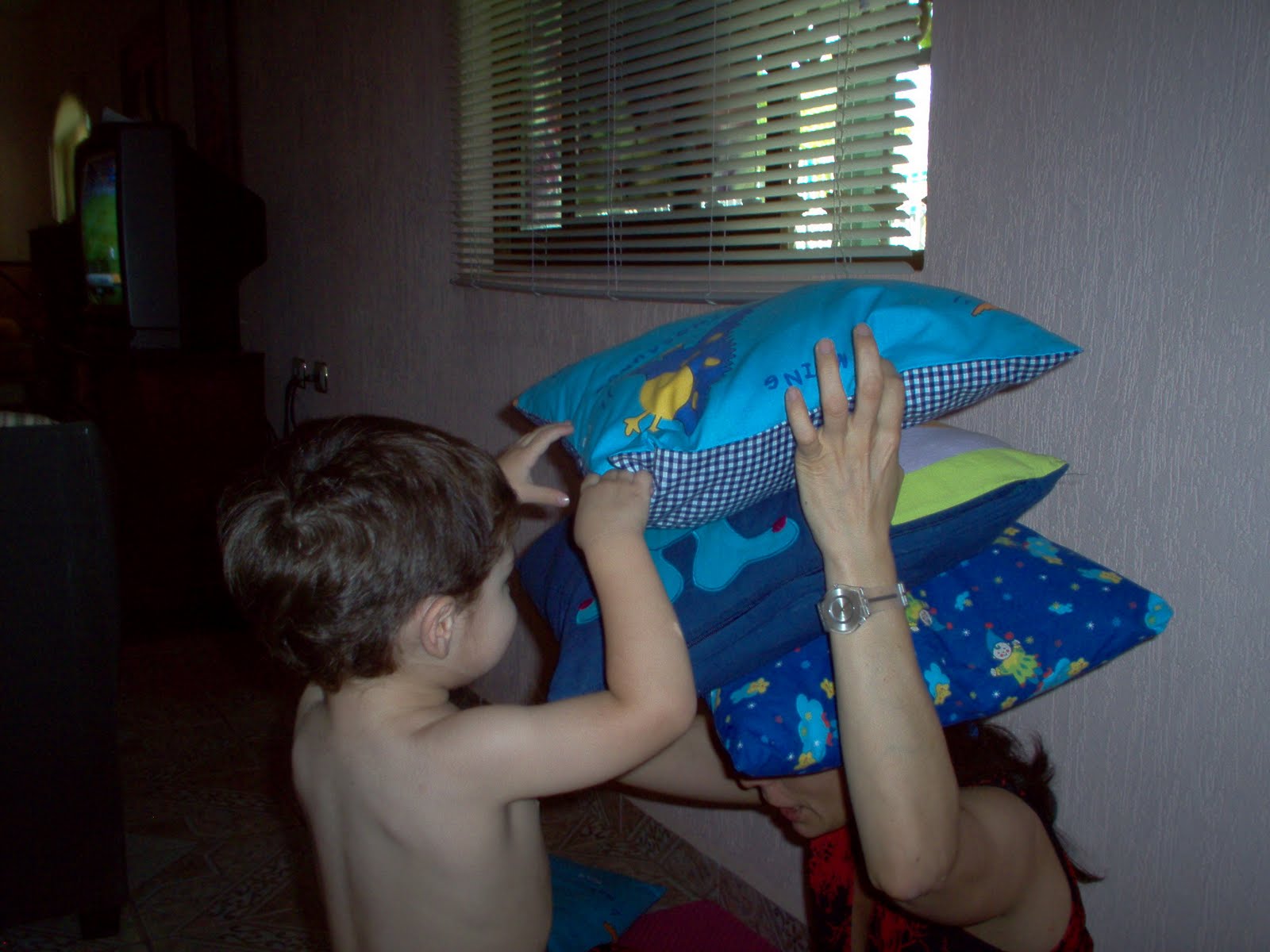
As we do not have a library here (and we must wait a month for Amazon shipments) I looked for some videos in Youtube. Ian loves Dr Seuss and “Ten Apples up on Top” has caught attention. As he engages very well with silly things, I began to play with books on top of me and he laughs a lot each time the book pile falls and now he plays the same game with his cushions, up on him and up on me, while counting. I noticed that although the sequence was correct, sometimes he counts one cushion twice. Then I realized that he does not understand the concept of one-to-one correspondence and especially that counting is more than just saying the number by rote.

Como no tenemos una librería aquí (y debemos esperar un mes para recibir los envíos de Amazon) busque algunos vídeos en Youtube. A Ian le encantan los libros de Dr. Seuss y “Ten Apples up on Top” captó su atención. Como él se involucra mejor en actividades si hacemos cosas absurdas y divertidas, empecé a poner y contar libros encima de mi cabeza y él se rio mucho cada vez que la pila de libros se caia. Ahora él hace el mismo juego con sus cojines, sobre él y sobre mí. He notado que, aunque la secuencia de números es correcta, a veces el cuenta un cojín dos veces. Entonces me di cuenta que no entiende el concepto de correspondencia uno-a-uno y especialmente que contar es más que simplemente decir los números de memoria.


After I read the chapter Mathematics Activities of Gettman's book, I was considering sensorial materials like Red Rods, Pink Tower, and Cylinder Blocks to prepare Ian’s skills for mathematics.
As we are following Lisa Nolan Curriculum for Toddlers I asked her for suggestions and this is what she said:

"If your child is 26, this is still too young to combine numbers and quantities over the number two or three, and even though your child may be able to do that, it is not a strong interest, yet.
Gettman's book is for ages three and up, and sensorial materials are more popular with that age group, less so with toddlers (this would include the number rods). So wait 10 to 12 months for your child to show a strong interest in sensorial materials and number rods.
Practical life activities are indirect preparation for math: there are a number of steps and a sequence of steps, so I'd focus on simple practical life. And toddlers love practical life, especially if it includes water! So continue with counting, and with numbers, wait on putting them together with number rods."


Después de leer el capítulo Mathematics Activities del libro de Gettman, estuve considerando usar materiales sensoriales como la Barras Rojas, la Torre rosada, Cilindros con Botón, para preparar las habilidades de Ian para las matemáticas.
Como estamos siguiendo el Curriculum para Niños Pequeños de Lisa Nolan, le pregunte su opinión al respecto y esto fue lo que me dijo:

"Si tu hijo tiene 26 meses, es demasiado joven para combinar números y cantidades mayores dos o tres y, aunque el niño puede ser capaz de hacerlo, es no es un fuerte interés, todavía.

El libro de Gettman es para niños de tres a cinco años, y los materiales sensoriales son más populares con ese grupo de edad, y menos con niños pequeños (esto incluye el las Barras Numéricas). Entonces, espera entre 10 a 12 meses para que tu hijo muestre un fuerte interés en materiales sensoriales y Barras Numéricas.

Las actividades de Vida Práctica son una preparación indirecta para las matemáticas: hay una serie de pasos y una secuencia de pasos, así que yo me enfocaría en actividades de vida práctica simples. Y los niños pequeños les encantan estas actividades, especialmente si se incluye el agua! Así que continua con actividades de conteo, y con números y espera para ponerlos juntos usando Barras Numéricas".

Thursday, May 13, 2010

Fine motor skills strengthening / Fortaleciendo la motricidad fina

Ian is going very well with the clothespin clamping activity.
On the other hand, he is having difficulties with the bottles and lids activity. So, I am considering putting this activity away. He wants to unscrew the lids to get the toys out from the bottles but he can do it so he asks me for help. When I open the bottles he focus on taking out the toys, which is tricky and I enjoy observing him trying different ways to resolve the problem. Today he placed the animal toys on the lids so I gave him more lids and animals toys to play. It was a good fine motor exercise to stand the toys up into the narrow lids.

Ian va muy bien con la actividad de abrir y cerrar pinzas de ropa, pero Por está teniendo dificultades con la actividad de abrir botellas. Entonces estoy considerando retirar esta actividad. Él quiere desenroscar la tapa para sacar los juguetes que he puesto en las botellas pero no puede hacerlo y me pide ayuda. Cuando abro las botellas Ian se concentra en sacar los juguetes, lo cual no es tan sencillo; a mí me gusta observarlo tratando diferentes maneras de resolver el problema.


Hoy el colocó los animalitos de juguetes en las tapas de las botellitas, así que traje más tapas y animalitos para jugar. Poner los animales de pie en las pequeñas tapitas fue un buen ejercicio para su motricidad.
As he enjoyed this activity I introduced two similar activities immediately:

The picture below shows a leftover chocolate box container from the Mother’s Day. I set up it with marbles for him to put in the circle dents. He transferred about the half of the marbles one by one until he got bored and tried to use both hands to transfer all the rest.

Y como el disfrutó esta actividad introduje otras dos similares inmediatamente.

Lo de la siguiente foto es el contenedor que quedo de la caja chocolate que John me regalo por el Día de la Madre. Ian tenía que tomar las canicas de la canastita y ponerlos en las cavidades. El transfirió cerca de la mitad de las canicas una por una hasta que se aburrió y trató de utilizar ambas manos para transferir el resto al mismo tiempo.


At that moment I had to understand that I must stop the transferring activities but I encouraged him to transfer marbles to a non-skid bathtub thingy turned over, using his hand. As it was not easy he gave up it very quickly.

En ese momento yo tuve que haber entendido que debía parar con los ejercicios pero al contrario, anime a Ian a transferir canicas en las ventosas de un antideslizante de ducha, usando su mano. Como la actividad no fue fácil la abandonó rápidamente.

Statement of principles/ Declaración de principios

I am exhausted. I have lost my focus. I already had said this: I need to limit the number of the resources I read (books, blogs, and web sites).
I received the Montessori books a month ago. I was so anxious when I read them, so I got more overwhelmed and I started surfing the web again to find out how other families are teaching their toddlers at home. I found Tot School and suddenly, I was following many, many blogs, thinking that I should implement activities such as those I saw there, for example children learning the alphabet. And I lost my focus. I thought to expand the curriculum Montessori I had planned for Ian to add a bit of this and a bit of that (what a mess!).
The result was stress, I was sat at the computer too many hours, eating poorly, sleeping less, forceless to play with Ian, sharing no meaningful time with my husband, without time to register my experience in this blog, and of course I forgot the routine I had established.

Estoy exhausta. He perdido el rumbo en todo sentido. Ya lo había dicho antes: necesito limitar el número de mis fuentes de consulta (libros, blogs, sitios web). Recibí los libros que tanto estaba esperando hace un mes, estaba tan ansiosa cuando los leí que terminé más abrumada y nuevamente recurrí a la web para ver como lo estaban enfrentando otras familias y fue cuando me encontré con Tot School, un excelente sitio donde muchas familias comparten sus experiencias educando a sus niños pequeños (menores que 4 años) en casa.
Así que de un momento a otro estuve siguiendo muchos, muchos blogs, pensando que “debería” hacer actividades como las que veía ahí, como por ejemplo niños aprendiendo el alfabeto. Y perdí mi foco. Pensé en ampliar el curriculum Montessori de Ian y agregar otras cosas.
El resultado fue estrés, yo sentada frente al computador demasiadas horas, comiendo mal, durmiendo poco, sin energía para jugar con Ian y apoyarlo con entusiasmo en sus actividades y sin tiempo para compartir con mi esposo ni tampoco para registrar mi experiencia en este blog y por supuesto olvide seguir la rutina que había establecido.

Now, I really need to write my basic principles, my priorities, my aims to educate Ian at home.

I want:

  1. 1. Ian has fun while developing his love for learning, self-confidence and independence
  2. 2. Enjoy this Montessori journey
  3. 3. Have time for myself and for my husband, every day
  4. 4. Trust my instinct as a mother
I am aware that in the future I will need to read this principles over and over again to get my focus back, and it is ok, I always could start again.

Entonces ahora tengo la necesidad de escribir mis principios básicos, mis prioridades, mis objetivos al educar a Ian en casa. Veamos que quiero:
  1. Que Ian se divierta mientras desarrolla su amor por el aprendizaje, su seguridad en sí mismo y su independencia
  2. Disfrutar este proceso
  3. Reservar tiempo para mí misma y para mi esposo, cada día.
  4. Confiar en mis instintos maternales
Soy consciente que en futuro deberé leer estos principios algunas veces para regresar a mi camino, pero esta bien, siempre podre volver a empezar.

Tuesday, May 11, 2010

Happy Mother’s Day / Feliz Día de la Madre

Mexico celebrates the Mother's Day on the 10’s of May. It was yesterday and John prepared a chocolate cake for me and Ian gave me a box of chocolate bonbons; it is a shame I do not have a photo of that moment because his did it very tenderly.

Ayer se celebró el Día de la Madre en México. John hizo una torta de chocolate e Ian me entregó una cajita de chocolates; que lastima que nadie le tomo un foto porque lo hizo tan tiernamente.

I must confess that I have not eaten none of them. However, Ian got his pronunciation of “cake” correct . Since he knows that “his” cake is in the refrigerator he often ask us to open it, asks by the name of the things we have there, practices his pronunciation, takes the heavy dish with the cake out, carries it to his table and calls for a piece of cake.

Debo confesar que no he comido ninguno. Sin embargo, Ian aprendió a pronunciar correctamente “cake”. El sabe que “su cake” esta en el refrigerador así que algunas veces al día el pide que lo abramos, pregunta por el nombre de las cosas que tenemos ahí, practica su pronunciación, saca el plato (que es pesado) de la torta, la lleva en su mesita y pide un pedazo.


With regard to the bonbons, Aunty Kathy and Ian have eaten all and left the best part for me :-) I mean the box which I am already using as trays for Ian’s activities and eventually I will introduce some one-to-one correspondence activities using the bonbons containers. But the best gift I received is the willing of Ian to try new activities.

Con respecto a los bombones, tia Kathy e Ian se los han comido todos. Para mi quedo lo mejor :-) la caja que ya estoy usando como bandejas para actividades de Ian y luego pienso hacer varias actividades de correspondencia uno a uno para Ian. Además de esos regalitos, Ian ayer estuvo muy dispuesto a intentar nuevas actividades.

Clothespins Clamping. I introduce this activity about three weeks ago, Ian tried it but it was so difficult for him so he did not want to try again. However, yesterday he seemed very interested on and stayed sat until he clamp all the clothespins on lip of bowl, still with my help. It is a good exercise for his muscle development and coordination. He is still learning how to pinch ends of the clothespins together using thumb, index and middle finger, to squeeze for open, to keep open, to move the clothespin over the bowl and to clamp on lip of bowl. Today we repeated the exercise.

Abrir y cerrar pinzas de la ropa. Habíamos intentando esta actividad hace como tres semanas, Ian lo intentó pero fue tan difícil y no quiso intentarlo más. Sin embargo ayer él se mostró interesado y se mantuvo sentado hasta poner todas las pinzas en el borde del tazón con mi ayuda. Es un buen ejercicio de desarrollo muscular y coordinación. El aún está aprendiendo como agarrar la pinza, como abrirla, como mantenerla abierta, como ubicar su mano para ponerla en el borde del tazón. Hoy día repitió el ejercicio.


Bottles and Lids. I attempted to present this activity previously without catch Ian’s attention. To motivate him for this activity I add a bottle with water in his water tray, so when his jug is empty his needs to open the bottle to refill it (see the photo bellow). He understood the idea, but as he could not open the bottle asked me for help.

Abrir botellas. También esta es una actividad que antes había intentado sin captar la atención de Ian. Para darle un proposito a esta actividad, agregue una botellita con agua a la bandeja donde Ian se sirve su agua. Así que cuando su jarrita esta vacia el necesita volverla a llenar desde la botella. El entendió la idea, pero como no pudo abrir la botella nos pidió ayuda.


For this activity I am using two different glass bottles and one plastic bottle, with lids of different colors and, to conserve his attention, I put some plastic animals inside them. At this time he doe not understand that he must to turn the lid in a single direction. As first exercise I am asking Ian only to open the lids and I am pointing the lid that corresponds to each bottle.

Esta vez, use solo tres botellitas distintas, con tapas de distintos colores y para captar su atención he puesto algunos animalitos plásticos dentro. En este momento él no entiende que debe girar la tapa en un solo sentido. Solo estamos trabajando en abrirlas y yo el indico que tapa corresponde a que botella.


Cleaning spills. When Ian crawled I cleaned the floor very often, then Ian began imitating me and every time we gave him a baby wipe or napkin, instead of cleaning himself he high chair or the floor. Therefore I thought that cleaning his spills would be something that he would do immediately when I would request so. But de did not. Since Ian get his water by himself, I put a sponge in his tray but he never used it until yesterday, yuppie! He not only cleaned the tray, but also cleans the floor and also his feet. After that I put a little bucket below his kitchen table (where the water tray is on) to squeeze the sponge into after cleaning, he actually did squeezed, but in the tray :-)

Limpiando derrames. Cuando Ian gateaba yo limpiaba el piso muy frecuentemente, entonces Ian empezó a imitarme y cada vez que le daba una toallita húmeda o una servilleta, en lugar de limpiarse a si mismo limpiaba su mesa o el piso. Entonces pensé que limpiar cada vez que derramaba algo sería algo que el haría inmediatamente cuando yo se lo pidiera. No fue así. Desde que Ian se sirve su agua por si solo, he puesto una esponjita en su bandeja pero el nunca la usaba, hasta ayer, yuppi! No solo limpió la bandeja, también limpió el suelo y también sus pies :-) Entonces puse un baldecito debajo de su mesita para que escurriera su esponjita después de limpiar, el lo hace, pero en la bandeja :-) poco a poco, estoy muy feliz de todas maneras.

Saturday, May 8, 2010

Red color recognition/ Reconocimiento del color rojo

In recent days we have done several activities using color red.

Durante los últimos días hemos hecho varias actividades usando el color rojo

Stamps and recognize shapes. To make these stamps I cut sponges and plastic bottles in the shapes that we are working with (circle, triangle and square); then I used silicone to glue each piece of sponge to its corresponding plastic piece; finally I glued, also with silicone, bottle caps in order to easily manipulate the stamps.

Estampar y reconocer figuras. Para hacer los sellos recorte esponjas y botellas plásticas en las formas que estamos trabajando (círculo, triangulo y cuadrado); luego use silicona para pegar cada pieza de esponja a su correspondiente pieza plástica; finalmente pegue, también con silicona, tapas de botellas para facilitar la manipulación.


Playdough and recognize numbers. I had tried several homemade recipes for playdough, but I never achieved a consistency appropriate for Ian. The one we use now is a commercial one, it is soft, its texture is pleasant and it has a delicious smell of cinnamon. Ian loves it and he is always tempted to eat it.

Jugar con plastilina y reconocer números. He intentado varias recetas caseras para hacer plastilina, pero nunca he logrado una de consistencia apropiada para Ian. La que usamos ahora es comercial, es suave, su textura es agradable y además tiene un delicioso olor a canela. A Ian le encanta olerla y siempre está tentado a comérsela.


Scribble, count and recognize numbers. When Ian was about 18 months old he loved to scribble with crayons, markers or crayons. Today it is not one of his favorite activities, but I am including it for the benefits it has for children, namely:
  • It helps develop independent thinking in children, since a scribbling child gets to think without bounds and without help from anyone.
  • It helps develop greater finger control in children, enabling them to be fast and efficient with activities such as writing or brushing.
  • It introduces children to the power of writing—through the process of scribbling, your child learns that a lot can be achieved by writing on a blank space.
  • It allows children to express their thoughts and feelings without any inhibitions. This can be a very good way of letting out both negative and positive emotions in a pleasant and subtle way.
I give him a numbered coloring page. Before he starts scribbling I name the objects, count them and name the number. He seems to be noting the differences between using color pencils, crayons and markers.

Colorear, contar y reconocer números. Cuando Ian tenía alrededor de 18 meses le encantaba garabatear con lápices, marcadores y crayones. Hoy no es una de sus actividades favoritas, pero la estoy incluyendo por los beneficios que tiene para los niños, digamos:
  • Les ayuda a desarrollar un pensamiento independiente , ya que un niño que garabatea llega a pensar sin límites y sin la ayuda de nadie más
  • Les ayuda a desarrollar el control de sus dedos, permitiéndoles ser rápidos y eficientes en actividades como escribir y cepillar
  • Les muestra el poder de la escritura –a través del proceso de garabatear, el niño aprende lo mucho que puede lograr escribiendo en un espacio en blanco
  • Les permite expresar sus pensamientos y sentimientos sin inhibiciones. Esto puede ser una buena manera de sacar emociones tanto positivas como negativas en una manera placentera y sutil
Para trabajar le doy una hoja para colorear números. Al empezar nombro los objetos, los cuento y nombro el número. Ahora el parece estar observando la diferencia entre usar lápices de colores, crayones y marcadores.


Increase vocabulary. Now that Ian has a strong desire to talk I am making some vocabulary cards again; he enjoys them very much.

Ampliar vocabulario – Ahora que Ian tiene un fuerte deseo de hablar he vuelto a hacer tarjetas de vocabulario y él las disfruta mucho.

Carrying Things / Llevando cosas

Some days ago, we bought some plants for our garden. When we began to unload the flowerpots from the car, Ian seemed very convinced that he could do it too. We saw him with his arms stretched out hoping that Daddy would give him a flowerpot. We gave him a light one and he carried it to the end of the line of flowerpots, then he returned for the following one, over and over again. He looked so serious, satisfied and proud of himself. I think he felt important and needed, so I am happy for having trusted him to help us.

Hace algunos días compramos algunas plantas para nuestro jardín. Cuando empezamos a descargar las macetas del auto, Ian parecía muy convencido de que él también podía hacerlo. Lo vimos con sus bracitos estirados hacia arriba esperando que Daddy le pasara una maceta así que le dimos una liviana, él la recibió y la cargó hasta el final de la fila de macetas y regresó por la siguiente, una y otra vez. Se veía tan serio, tan satisfecho y orgulloso. Pienso que se él sentía importante y necesario, así que estoy feliz de haber confiado en él para ayudarnos.


Now I understand how important it is that he participates in our family activities: it is the best way that he learns how to use his body and his mind with a purpose, to concentrate, to complete activity cycles, to finish what he starts and, the most important thing, to contribute in an important family task.
Since then he has enjoyed walking, ascending and descending stairs, climbing around the house while carrying the flowerpots carefully. It has been a good exercise to control his movements.

Ahora entiendo la importancia de que el participe en las actividades familiares: es la mejor manera de que él aprenda a usar su cuerpo y su mente con un propósito, a concentrarse, a completar ciclos de actividad, a terminar la que empezó y lo más importante a contribuir en un trabajo importante para la familia.
Desde entonces el ha disfrutado cargando las macetas alrededor de la casa, subiendo y bajando gradas, trepando, sin perder atención por su maceta. Ha sido un buen ejercicio para controlar sus movimientos.


Another exercise that he has enjoyed these past days has been to roll and unroll his mat and to put it in its place.

Otro ejercicio que ha disfrutado estos días ha sido enrollar y desenrollar su alfombra y ponerla en su lugar.

Thursday, May 6, 2010

Paying attention to words / Poniendo atención a las palabras

Lately Ian has been very focused on talking and, his books and music CDs are his best sources to learn new vocabulary. His favorite book at this time is Llama Llama Red Pajama("Sha Sha" for him)

Últimamente Ian está muy focalizado en hablar y los libros y sus CDs de música son sus mejores fuentes para aprender nuevas palabras. Su libro preferido en este momento es Llama Llama Red Pajama(Sha Sha para él)

Llama Llama Red Pajama

The book addresses the fear that so many little children (such as Ian) feel when their moms leave their rooms at night. The story is narrated in rhyming fashion and the facial expressions of the illustrations are great.
Ian loves this book (I guess he understands the story very well) and he wants us to read it over and over again. His is more and more participating during reading: he is completing the phases increasingly (shyly, when he does not pronounce well the word and triumphantly when he thinks he has got the pronunciation correctly ), or, mimicking the behaviour of the little llama, which is so hilarious and cute (see the photo below where he's "wating wating for his mama...")

El libro aborda el miedo que tantos niñitos (como Ian) sienten cuando su mamá sale de su habitación en la noche. La historia está narrada en rima y las expresiones faciales de las ilustraciones son geniales.
A él le encanta la historia (supongo que entiende muy bien de que se trata) y quiere que la leamos una y otra vez. Su participación es cada vez más activa: completando las frases (tímidamente cuando es una palabra que aun no pronuncia bien y muy eufórico cuando cree que ha logrado la pronunciación correcta) o, dramatizando las emociones y las acciones, es tan divertido, como en la foto de abajo donde esta "esperando, esperando por su mama...".


His favorite music CD is Yummy Yummy of The Wiggles. It is not new, however, the manner in which Ian heard it now is new. When he wants to listen (several times a day) he says "to to" (for "Hot Potato", one of the songs) shaking his arms and head (so cute) and stays in his room, so concentrated that he forgets that I am not with him. When I observe him secretly, sometimes he is very quiet, surely trying to understand the lyrics, other times singing the words he knows, dancing at other times or playing his instruments.

Su CD de música favorito es Yummy Yummy de The Wiggles. No es nuevo, sin embargo la manera en que Ian lo escucha ahora es nueva. Cuando quiere escucharlo (varias veces al día) dice “to to” (por Hot Potato, una de las canciones) sacudiendo brazos y cabecita (tan lindo él) y permanece en su habitación, tan abstraído que olvida que yo no estoy con él. Para no cohibirlo suelo espiarlo y a veces lo encuentro muy quieto, parece estar tratando de entender las letras, “cantando” las palabras que conoce, bailando otras veces o tocando sus instrumentos.


Speaking of instruments, we use a can of coffee as a drum. I have not emptied its content because sometimes he opens the lid and enjoys the coffe smell, it is also a good practice for him to remove and put the lid of the tin. Today, while we was listening to The Wiggles, alone, I smelt a delicious coffee smell, when I went to his room, he was spreading the coffee all over his body, he appeared to enjoy the feel so I left him and only when he finished I gave him a spoon to scoop back the coffee to the can. A mess that became a source of learning.

Hablando de instrumentos, usamos una lata de café como tambor. No he vaseado su contenido porque a veces en la abre y disfruta de su olor (me dice “smell” y me acerca la lata), también es una buena práctica para el quitar y poner la tapa de la lata. Hoy día, mientras escuchaba a The Wiggles, solo, empecé a sentir un delicioso olor a café, cuando fui a espiarlo, estaba esparciendo el café sobre sus él, parecía disfrutar tanto la sensación que lo deje solo y cuando terminó le di una palita para que regresara el café a la lata. Un desorden que se convirtió en una fuente de aprendizaje.


LinkWithin

Related Posts with Thumbnails